CHOOSE YOUR PAYMENT METHOD
×
Pay with Credit Card
Pay with Bank Account (ACH)
Close
TALK TO AN EXPERT
×
[forminator_form id="1909"]
Close
  • Skip to main content
Spring Special: $79 First Treatment (Save $200)
Redeem Offer
  • Services
    • Ants
    • Bed Bugs
    • Cockroaches
    • Fleas
    • General Bugs
    • Moles and Gophers
    • Rodents
    • Spiders
    • Wasps
  • Locations
    • Portland
    • McMinnville
    • Newberg
    • Salem
    • Willamette Valley
    • Eugene
    • Roseburg
    • Southern Oregon
    • Oregon Coast
  • Plans and Pricing
  • Contact us
  • More
    • About Us
    • Blog
    • Commercial Pest Control
    • Frequently Asked Questions
    • Meet Your Technician
    • Pay Bill
    • Privacy policy
541-636-0146

Archives for July 2024

Boxelder Bugs and Stinkbugs

July 1, 2024 by Jacob Lander

Boxelder bugs and stinkbugs are two pests we get calls for year-around.  Both true bugs, they’re nuisance pests that congregate in huge numbers on our homes and vehicles.  Dealing with them can be a hassle, and even from a pest control viewpoint, they’re not the easiest pests to remove.  Let’s take a little time to get to know them and why they haunt our homes each year.  A better understanding of these pests can help you determine which actions you’d like to take, and what a pest control professional can do to alleviate the problem from your home.
Crucial Information About Boxelder Bugs and Stinkbugs

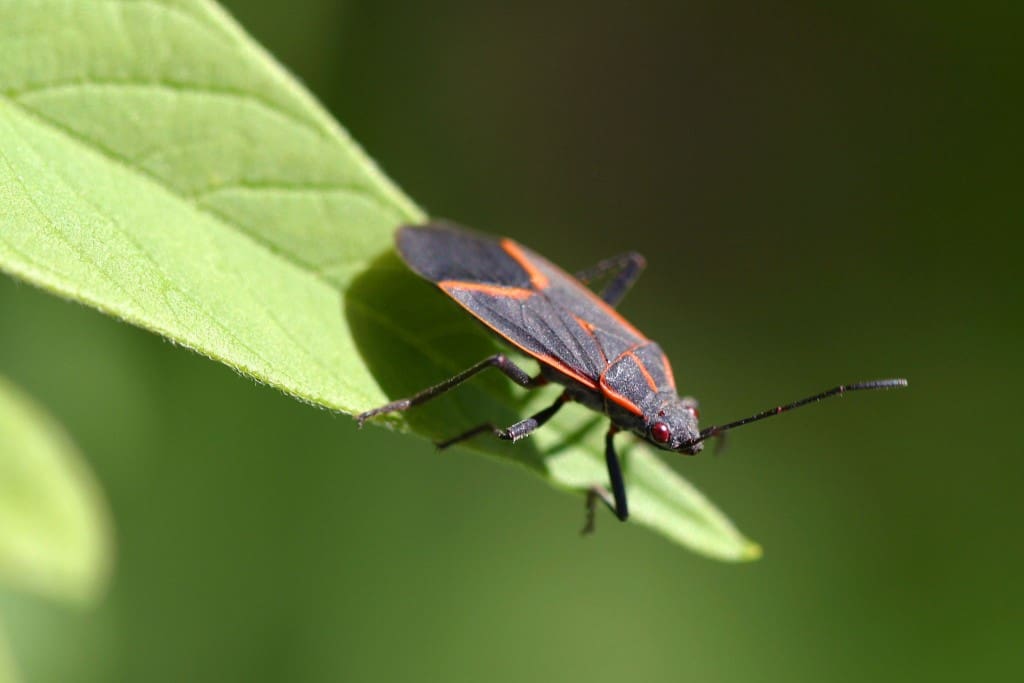
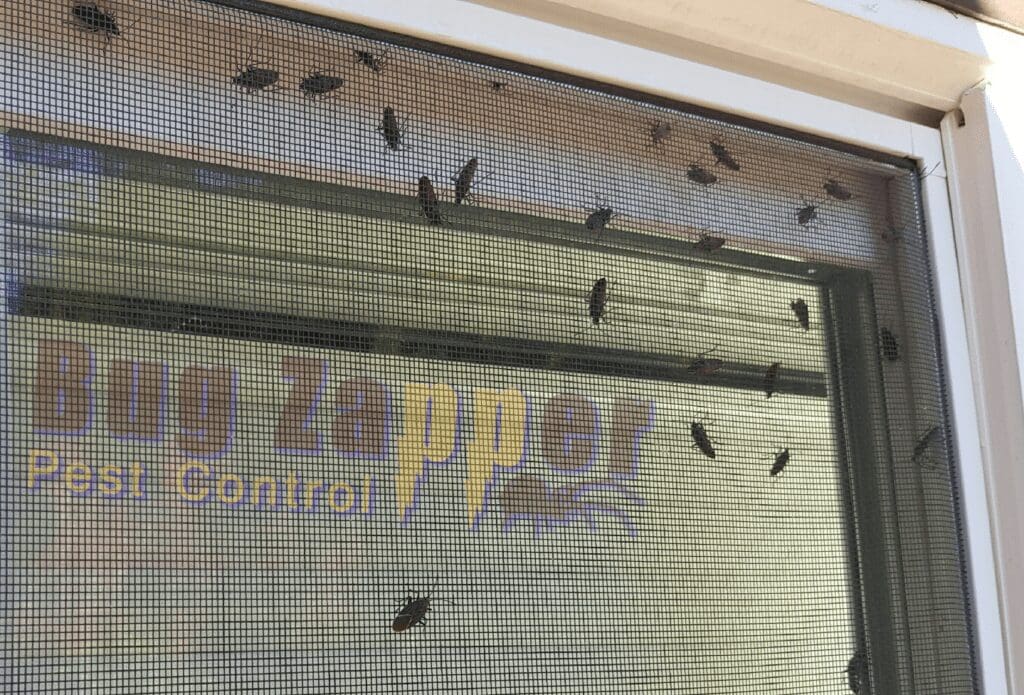
There are many types of elder beetles, but boxelder bugs are likely the biggest nuisance among them, and certainly so in our region.  Boxelder bugs (Boisea trivittata) have a tell-tale red design on their backs (see below), and are somewhat small, black, and move slowly most of the time.  They fly well and can be found buzzing around certain trees and the walls of your home when it’s warmer out.  Typically, they’re seen mobbing specific trees, from their namesake boxelder trees, to others, like maple and ash, and even certain fruit trees, as well.  This makes elder bugs more common in rural areas, but most downtown areas have fruit trees and other favorites here and there, so these pests can be found just about anywhere.  They usually breed on and around these trees in the spring and summer, and even into late autumn.  They will also feed on the trees if possible, with a diet that consists heavily of maple seeds.  These insects use modified sucking mouthparts to pierce the leaves of  trees, looking for water, though this behavior doesn’t damage the tree or cause any real problems in the long run.  To a boxelder bug, the warmer the area, the better, so they can be found most often on the western or southern sides of trees and rock walls.  For our purposes, we’ll focus on the most common of these types of bugs in the Pacific Northwest:  The boxelders, stinkbugs (specifically the highly invasive Brown Marmoted Stinkbug, Halyomorpha halys), and shield bugs (varied, family Pentatomidae).  All three of these function in very similar ways, and end up on your home for essentially the same reasons, during the same times of year.
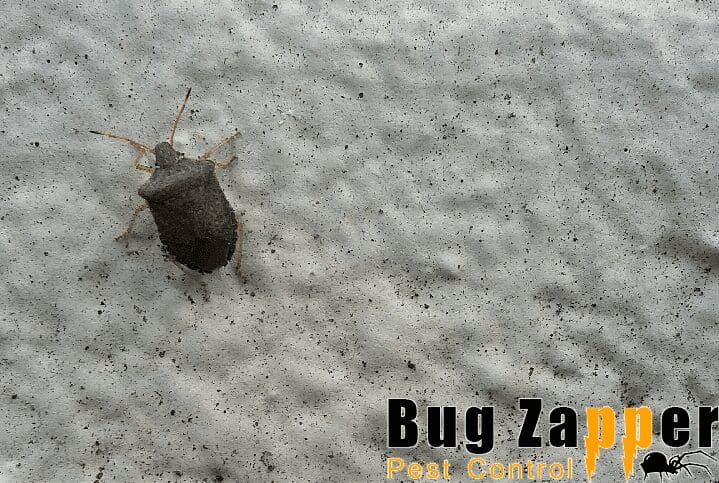
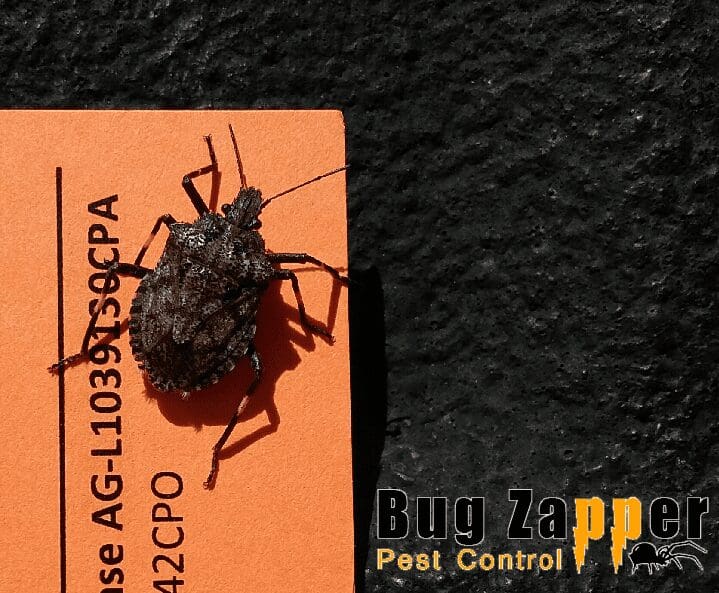
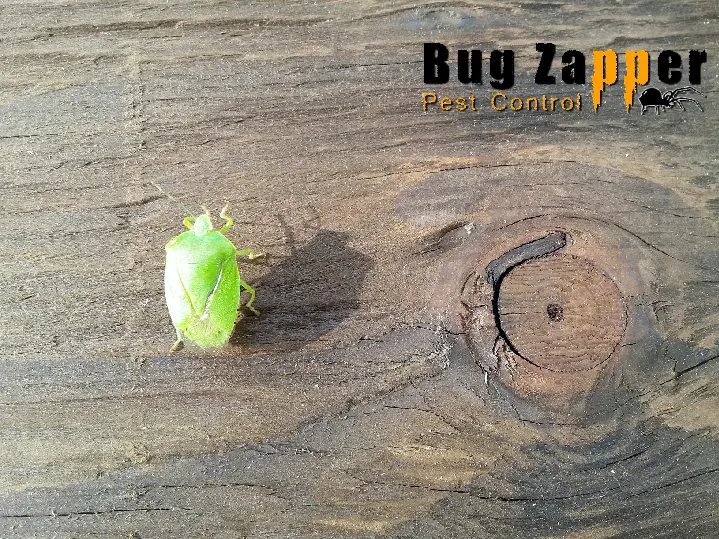
One of the many types of common stinkbugs/shieldbugs.
The highly invasive Brown Marmoted Stinkbug.
One of many types of Elder Bug.
The Green Shieldbug (or Green Stinkbug). Bonus: Rarer than others and less stink when crushed!
The common Boxelder Bug. Also, the most likely reason you’re reading this article.

Where Your Home Comes In…

For our concerns, we’ll focus on the place they are often found that will concern you the most:  Your home.  Boxelder bugs are attracted to the warmer exterior walls of structures.  While they’ll get just about anywhere, the majority of them will be on those walls warmest to the touch. Their purpose in massing on your home is both reproductive (spring and summer) and shelter (fall and even into winter).  While you may find large numbers of them on your home in the earlier months, the cold pushes them to seek shelter in the Fall, so they become more prevalent as a nuisance pest in the later portion of the year.  Boxelders, in particular, are incredibly sensitive to temperature shifts, and will move toward warmth in the colder months with much energy.  As a general rule:  If it’s warm, they can get in there.  Elder bugs specialize in penetrating hard-to-reach places, and when winter approaches, they’ll need to hide in a heated place, remaining there and barely moving until warmer weather arrives.  This overwintering results in a mass emergence in the spring, as the previous generation emerges to reproduce quickly, thus beginning the cycle all over again.  If you have a large mob of elder bugs on your home this year, you can rest assured that the problem will contribute heavily to having them again next spring.  They’ll do this when they re-emerge and start reproducing, and most likely, where they already live:  Your home.
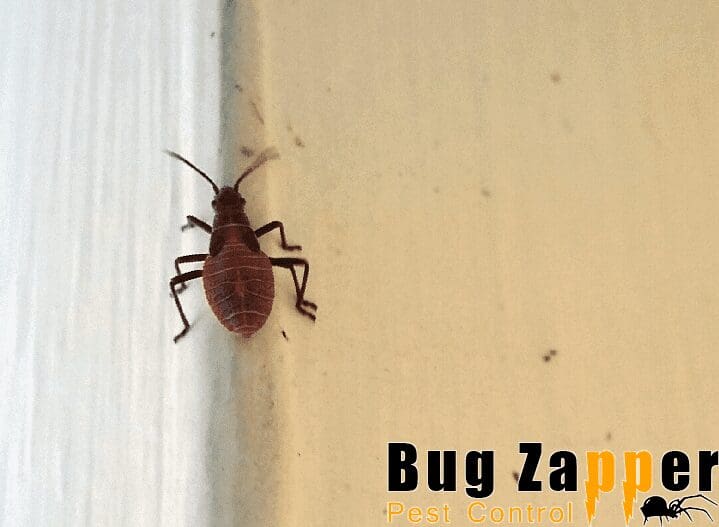
Pictured:  Home.  Also pictured:  Boxelder bug in later juvenile stage.  Note the broader, red pattern and “chubbier” shape (they’re not actually chubby, just big-exoskeletoned).

The Damage Caused

Luckily, elder bugs do not bite or sting, and generally have no interest in human beings at all.  Neither do they have much interest in your houseplants or pets.  Generally, if you find elder bugs near your houseplants, they’re simply thirsty and looking for water wherever they can get it.  Also, elder bugs rarely cause any sort of damage to your home, physically (though they can clog vents).  However they can be a nuisance in other ways.  If you’ve just painted your home, they can be a real problem landing and dying in your paint, causing you to have to scrape them down and go over all of it again, or tracking through it and then walking across your windows, causing a fairly miserable cleanup attempt on your part.  The most common problem you’ll have with boxelder bugs and stinkbugs, however, is seeing them; they’re easy to spot, look like wasps from more than a few feet away, and thousands of large bugs crawling all over you house can be very unsettling.  Worse, they might begin entering your home, at which point you’ll find them all over the place, and especially near warmer windows and walls.  Their lifespan is quite short, as well, meaning that they can get inside your home and perish there, causing you to have to sweep them up over and over again. They also leave a great amount of waste behind, and no one wants bug excrement in their kitchen (or anywhere, for that matter).
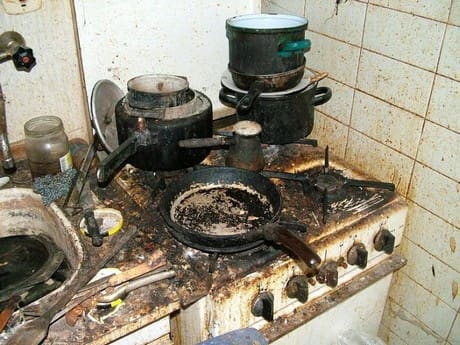
Well, most of us, at least.

Another important problem with elder bugs is that when crushed, they can stain the material they are on.  If you have boxelder bugs in your home, try not to crush them, as you can inadvertently leave stains behind that are difficult to get rid of.  They also can release a minor odor that can be problematic when large numbers of them are killed quickly.  In the case of stinkbugs, the problem is worse:  They can leave a stain behind, yes, but also a much more noxious odor that is slow to dissipate, hence the name.  Also, Stinkbugs are larger and somewhat noisy when flying, and will often mass into huge flying swarms next to your house.  The intense sound this makes is extremely unnerving and approaching this swarm of hundreds (or even thousands) will inevitably result in you getting smacked in the face more than a few times.  Our technicians have encountered this “cloud of noise” numerous times.  It “sounds like someone is flying a drone around your head.”  This behavior is unnerving and unwanted, to say the least, especially when you’re just trying to leave your house and don’t want to get into your car while covered in large insects that smell awful.

All this from smashing a bug?

What Else?  Flight.

Due to their specialized habit of roaming our outer walls and windows, elder bugs, and specifically boxelders and stinkbugs, can be real nuisance pests, and dealing with them can be particularly troublesome.  Unlike other household problems like spiders or ants, elder bugs can fly, and they do it very well.  This means that they typically won’t arrive on your wall by climbing up from ground level.  In turn, it also means that standard pesticide barriers are far less effective on them than on ants or spiders.  Flight changes everything, and it’s also one of the biggest contributors to the spread of the Brown Marmoted Stinkbug, which is invasive and a real pest to our regional agriculture.  These now-common stinkbugs did not exist in our region even 30 years ago, but are now a constant sight in the Summer and Fall months.  We see them so often that it just seems they’ve always been here, but your parents generation grew up in a Pacific Northwest that did not include these heavy, stinky pests.  If that’s not bad enough, there’s a newer development that has come to light, as well:  Boxelder bugs, in some instances, have been documented feeding on not only paper wasp larvae in wasp nests, but on dead mice.  This is surprising as they have not, to date, been considered carnivorous.  This is an uncommon find, however, and it remains to be seen if boxelders, as a species, will commonly use these methods for feeding, or if these are isolated incidents among a very small sub-group.
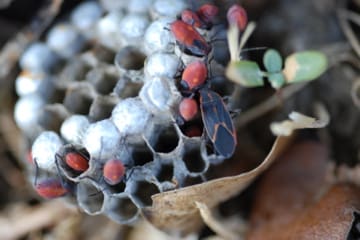
Copyright Suzanne Watson

How to Handle Pests that Fly

The ability of some insects to fly changes, by necessity, the way in which your pest control expert handles a particular pest.  With wasps, there is always a nest nearby, and the most successful tactic in removing a wasp problem begins with that nest, and ends in a barrier treatment where wasps are likely to attempt building a new nest.  Translated:  We remove the nest, then treat your eaves to keep wasps from building another (Paper Wasps/Bald Faced Hornets), or we dig up the nest and remove it from the ground physically, and then carefully treat that area to keep the nest from being rebuilt (Yellow Jackets).  This works wonders and is always 100% effective, but here again, we have a problem with elder bugs.  Boxelder bugs and stinkbugs don’t nest the way wasps do, but rather spend their time hatching from various places and then can mass on the sunny, warm walls of your home.  There is no singular nest to remove, or singular place to treat, like your eaves or base perimeter, that will solve the problem.  They land on your walls and windows and walk about looking for mates, and then, when mating has concluded, they burrow in and hide, much in the same way winged ant queens seek out overwintering spots in the fall.  It’s all about eating, mating, and then surviving the winter to start out the next generation.

To be honest, it’s pretty much the same for us.

So how can elder bug problems be treated?  The answer to this involves a multi-tiered solution, in which several approaches are utilized.  The best method is in using a series of clever spot treatments, crack and crevice treatments, and occasional surface sprays to keep them from massing on your walls.  The fewer there are on your wall, the fewer will be attracted to that wall for mating purposes, and those that do approach, for the warmth, will be greeted by a repellent that makes the area unpleasant for them, or that kills them if they choose to overstay their welcome.  In this manner, a good pest control technician will employ several approaches and products, including and especially a repellent, and the treatments applied should be residual, meaning they’re focused on long-lasting protection, rather than a quick (and fading) knockdown effect.  The idea is to cut down their potential for congregating on your wall to the point that they find some other place to congregate (or perish trying to live on your structure), thus removing any need for further bugs to land and try the same.

We’re Bug Zapper Pest Control.  Boxelder Bugs and Stinkbugs are no problem for us!  We’re locally owned for fast, exceptional service.

5 Star Pest Control Service available in Albany, Ashland, Corvallis, Eugene, Grants Pass, McMinnville, Medford, Newberg, Roseburg, Drain, Sutherlin, Salem, Sweet Home, Scio, Lebanon, Sherwood, Wilsonville, Woodburn, Tigard, Tualatin and surrounding areas.

Locally owned pest control with same day service— 100% guaranteed!

Learn More

Call or Text

(541) 636-0146

For Information Today!

Read Article

Filed Under: Pest Control

Black Widow Spiders in Oregon – Danger!

July 1, 2024 by Jacob Lander

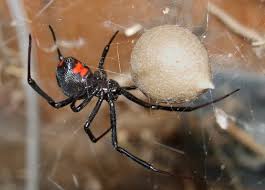
Nothing strikes fear in the heart quite like Black Widow spiders! And rightly so. Their bite can be fatal to humans, particularly for the elderly, infants, and anyone with a compromised immune system due to other illness.  Black Widow spiders in Oregon are a real threat, and we encounter them often, most times of year.

What Do Black Widow Spiders Look Like?

Black Widow spiders have eight long spindly black legs. The females are easily recognized by their black round bodies with a red or yellowish hourglass shape on the underside of their abdomen. The abdomen is usually about 1/4 inch in diameter but may be  swollen to 1/2 inch in diameter when it is full of eggs. Males are smaller, lighter colored with streaks on their abdomen.

Black Sidow Spider

Learn how to identify other dangerous spiders in Oregon.

Where Are Black Widow Spiders in Oregon Found?

We find Black Widow spiders nearly anywhere protected from the rain in Douglas County, with quite a few spotted in Lane county, as well.  Linn and Benton counties see fewer of them, though the can be common in crawlspaces in neighborhoods here and there.  Josephine county has a larger number of them, especially in the mid-Summer months. Common nesting locations include inside meter and sprinkler valve boxes, wood piles, crawl spaces and under house eaves. Their Webs are an irregular mass of webbing including a central place for retreat. There webs are not usually found indoors.

What Are Black Widow Bites Like?

Many factors like location on the body, temperature, season, body size of the victim, depth of the bite and amount of venom injected affect severity of reaction to a Black Widow bite. Bites often produce a rapid sharp pain like a pin prick and then disappear rapidly. Black Widow bites can be fatal to children and elderly victims and medical attention should be sought for anyone suspecting a Widow bite.

Black Widows are not aggressive and the rare defensive bite occurs from sitting on the spider etc. Anyone suspecting a Black Widow bite should try to capture the spider to take to the hospital for positive identification. An anti-venom specific for the Black Widow spider bite is readily available to most physicians. Male black widow spiders are harmless to humans.

What Does Black Widow Venom Do?

It is reported that the Black Widow’s venom is more potent than rattlesnake venom. To feed, Black Widow spiders puncture their prey with fangs and inject digestive enzymes into the corpse. These enzymes, liquefy their prey’s bodies and then the spider sucks up the resulting fluid for a meal.

Fun Fact: Black Widows are actually called widow spiders because they kill their mates after mating, and often EAT THEM.  Talk about a bad date.

Black Widow Spiders in Oregon- Control Solutions

Black Widow spiders are easily controlled by our trained technicians. Control methods are highly effective and are 100% Guaranteed. Let our trained technicians accurately identify Black Widow spiders and help you find the best solution.

Call 541-636-0146 or contact us here to schedule today.

Locally owned for fast, exceptional service.

5 Star Pest Control Service available in Albany, Ashland, Corvallis, Eugene, Grants Pass, McMinnville, Medford, Newberg, Roseburg, Salem, Sherwood, Wilsonville, Woodburn, Tigard, Tualatin and surrounding areas.

Call/Text 541-636-0146 For Information Today!

Call or Text

(541) 636-0146

For Information Today!

Locally owned pest control with same day service— 100% guaranteed!

Learn More
Read Article

Filed Under: Pest Control

Carpet Beetle Bites

July 1, 2024 by Jacob Lander

Have you noticed tiny red bites on your skin or that of a loved one when you wake up in the morning? If you’re concerned about a potential infestation in your home and want to determine whether these are bed bug bites, you’re in the right place.

We understand and see it very often. The idea of something feeding on you in the night is disturbing, and you’re definitely justified in panicking. You probably suspect you have bed bugs, and you might, but often, what seems like a bed bug infestation is actually a flea infestation or, as is quite common, an infestation of carpet beetles.

With bed bugs and carpet beetles, what’s the difference? Unlike bed bugs, carpet beetles do not bite and cause an allergic reaction. So which do you have? We’re here to help!

Identifying bed bug bites and carpet beetle bites is one way to find out which is in your home. Let’s go over some of the details of bed bug and carpet beetle infestations so you can have a better idea of what’s happening in your home by looking at these insects’ appearances and bite markings.

Carpet beetles and bed bugs can have similar “bite” patterns and inhabit many of the same locations in your home.  Both can be difficult to detect, and have many of the same results: itchy “bites” that occur while you sleep in your bed. They can be very easily confused with each other.  Here’s what you need to know to best determine which infestation has taken root in your home.

How to Identify by Appearance

Bed Bugs

Bed bugs are usually reddish and semitranslucent. They often cluster in the seams of your bed or near the trim that separates your carpet from the walls.  They  may be seen in the daytime or at night depending on your sleep patterns and the level of infestation, but are most likely to be active whenever you are sleeping.

Carpet Beetles

Carpet beetles are usually quite small, but adult carpet beetles can grow to nearly ladybug size. After a larval stage, they can be found in carpeting, along trim, in your windowsills, your bedding, and just about anywhere. In the Pacific Northwest, they have a black, brown, and grey color pattern, but black and blue is common, as well.

Bed Bugs vs Carpet Beetle Bites

People react differently to affects of bed bugs and carpet beetles. Two people sleeping in the same bed may both be getting bitten by bed bugs but one person is covered in red bite marks and the other has no apparent bite marks at all. Therefore, trying to identify insect type based strictly on bite patterns or skin appearance is not recommended.

(c)Joel Carillet

Bed Bugs

Bed bugs require a “blood meal” to grow and reproduce, and they will have this meal many times during their life span. The feeding often leaves bite marks on your skin, and these may or may not appear in groups of three as is commonly believed.

They are attracted to the carbon dioxide and your slowed breathing as you sleep or rest–such as when you watch tv. Bed bugs will adapt to be active whenever you sleep whether that be at night or in the daytime and will actively seek you out for a blood meal.  We have seen them travel between where they live and a blood meal up to about 30 feet and they will even  relocate to other rooms, in search of a meal, fairly quickly if their food source (you) is absent long enough.

Infestations begin small but can quickly increase, especially if they’ve been feeding on you or a family member for months. An adult female can lay up to five eggs per day, without end, so long as she’s able to feed at night. Bedbugs will infest your home, specifically to feed on you, so they can grow and reproduce, and that is their end goal.

Carpet Beetles

Carpet beetles end up in our homes somewhat accidentally, and they do not need humans as a part of their diet or life cycle. They can be brought in on feathers, older bedding, wool (especially), on pets, and even in some bulk grains. They do not feed on people, but rather, they simply end up on us as they forage for food and water. The “bites” they leave behind on us are actually not bites at all.

Carpet beetles have tiny filaments, like small hairs, on their bodies, and these can cause an allergic reaction in humans. As these insects crawl across you, or drop these hairs on surfaces you contact, the hairs irritate your skin and can bring about small rashes or marks as an allergic reaction, which do look very much like bites but are actually just skin irritation. This is called carpet beetle dermatitis and is not commonly dangerous to one’s health. The allergic reaction may become more severe  over time, and often, a carpet beetle infestation will go under the radar until someone begins having the reaction, which can take time to build up. At this point, the infestation may  have grown quite large. By the time you realize there’s a problem, a sizable infestation is likely already present in your home.

Larval Stages of Bed Bugs and Carpet Beetles

One big difference between bed bugs and carpet beetles that can help you determine which pest you’re dealing with are differences in the larval stage of each.

Bed bugs go through an “incomplete” metamorphosis while carpet beetles go through a “complete” metamorphosis. What this means is that bed bugs have no larval stage. They hatch from eggs looking somewhat like miniature versions of adults. Carpet beetle eggs hatch into larvae, which have a different appearance than adults do. Carpet beetle larvae are actually larger than their adult forms are and resemble wormlike tiny creatures or even small silverfish.

The larvae can be found in your carpet, especially near the trim where the carpet meets the wall; under your bed; and in small carpeted nooks and crannies. What does this mean to you? If you find larvae in your bedroom, chances are high that you have a carpet beetle infestation and not that of bed bugs. While it’s possible to have both, that’s usually fairly rare.

How to Get Rid of Carpet Beetles: The DIY Route

Carpet beetles may not be disease-carrying insects, but because they have a huge appetite, they are likely to be a problem at your home. These creatures may rely on natural fibers for their food source and end up ruining whatever fabrics, clothing, or upholstery you have. If you have the time and want to try handling things yourself, you can try the following to avoid or purge an infestation of carpet beetles:

  • Steam-clean or vacuum items. Carpet beetles are attracted to dust bunnies, animal hair, and lint, so usually thorough vacuuming of hard to reach areas is the first step. Make sure to clean those hard-to-reach, dark corners thoroughly and regularly because carpet beetles thrive in undisturbed areas with plenty of dust. We suggest vacumming under beds and dressers and other carpeted areas that rarely get cleaned. If you prefer a stronger option, steam-clean your carpets so the heat will kill the carpet beetles. You may  have to steam-clean multiple times just to make sure the larvae and eggs are completely gone.
  • Use white vinegar or apple cider vinegar (without water). This is another common home remedy that may help. Simply pour the vinegar into an atomizer spray bottle, and spritz on fabrics or places where carpet beetles are likely to infest. Alternatively, you can mix peppermint oil and clove oil with water and spray this on such surfaces. If you find carpet beetles on your clothes or textiles, you can wash these items in a mixture of vinegar and water or in soapy, hot water. Take note, though, that there are certain items and fabrics that should not be washed with vinegar; otherwise, they can be damaged or ruined. Carpet beetles are especially fond of wool and silk, but you should check first if they can be washed using the washing machine. Otherwise, these should just be hand-washed.
  • Use vacuum pack bags. Clothes that are worn only during certain seasons or special occasions should be kept in garment bags so they don’t accumulate dust or attract carpet beetles.
  • Seal all possible entry points. Use caulk to seal holes, cracks, and crevices where carpet beetles may pass or enter. For windows, use bug guards, and if your screen doors need fixing, use screen repair tape.

Call the Experts

In contrast to DIY methods that are often  just temporary solutions, so if the infestation persists or you don’t have the time to get rid of carpet beetles yourself, you can give us a call anytime to schedule a PRO treatment. Regardless of which pest you’re dealing with, we can help. Bug Zapper Pest Control gets 5-star reviews because we are  no stranger to bed bugs or carpet beetles, and we can rid you of these pests professionally and quickly. Our 100% guarantee means that you’ll be pest-free in no time, and our can-do attitude and fast response time are instrumental in helping you solve your pest problems!

As you can see, the “bite” patterns of Carpet Beetles vs. Bed Bugs, despite being different, still look very similar. They can sometimes be very difficult to determine. Our team of experts can help you determine with certainty which you have.

Check out this helpful video for more information about Bed Bugs

If you need an inspection to determine if you have bed bugs or carpet beetles contact us or give us a call to talk with our friendly and knowledgeable staff.

5 Star Pest Control Service available in Albany, Ashland, Corvallis, Eugene, Grants Pass, McMinnville, Medford, Newberg, Roseburg, Salem, Sherwood, Wilsonville, Woodburn, Tigard, Tualatin and surrounding areas.
Call or Text

(541) 636-0146

For Information Today!

Locally owned pest control with same day service— 100% guaranteed!

Learn More
Read Article

Filed Under: Pest Control

How To Prepare for a Bed Bug Inspection

July 1, 2024 by Jacob Lander

Bed bugs are one of the few pests that truly terrify people. A professional bed bug inspection and treatment will identify the extent of the problem and quickly eliminate the unwanted pests.

If you suspect you have bed bug bites—likely because of the tell-tale red bite marks they leave on you and your family members—it can lead to anxiety and fear, which can feel uncontrollable. Scheduling our team of bed bug experts is the easiest way to restore the peace of mind you and your family deserve.

Bed bugs are notoriously difficult to find and wipe out, but preparing for bed bug extermination will help our experts do their job: the specialized work of finding where the bed bugs are, learning how far these creatures have traveled, eliminating them, and making sure that the proper steps are taken to prevent a re-infestation

Here are some things you need to know about the process of preparing for a bed bug treatment so you can eliminate your family’s worries.

Step 1: Bed Bug Inspection

Having a professional inspect for bed bugs as part of the first treatment allows a trained technician to make adjustments in the treatment plan based on the following:

  • What life stage the bed bugs are in
  • Where they are getting their feeding source
  • Where their shed skins, eggs, breeding grounds, and travel lines are found.

By completing an exhaustive search of your home, our experts are much better equipped to craft a treatment plan that will eradicate adult bed bugs and their offspring quickly.

A typical bed bug inspection is completed just prior to completing treatment and takes about 30 minutes to complete. A professional will check your beds, nightstands, baseboards, couches, sofas, wheelchairs, and any other places where people sleep, relax, or watch television for an extended duration.

Once the inspection is carefully completed, you will be provided details regarding our findings. In the event of mistaken identity, we’ll give advice on what to do next.

Step 2: Bed Bug Treatment

How to Prepare Your Home for Bed Bug Treatment

Our bed bug inspection and treatment is completed on the same visit to avoid delays in effectiveness. Prior to our arrival you’ll need to ensure that your home is ready for the inspection and treatment of bed bugs.

Prepping your home for a bed bug extermination takes time. Following these steps in advance to prepare your home for a bed bug treatment will help ensure the fastest results.

(Warning: Completing every step is mandatory to a successful treatment. If all preparation steps are not completed upon arrival, then your first treatment may need to be rescheduled.)

  1. Pick up clothes on floors and hanging over chairs and run through a hot dryer cycle for a minimum of 40 minutes. Place, these clean dry clothes in a large garbage bag sealed at the top until the treatment has been completed.
  • Cabin beds/beds with built-in storage. Remove all clothing items from these storage areas and dry at high heat for a minimum of 40 minutes. Place these clothes in a large garbage bag sealed at the top until the treatment has been completed.
  • De-clutter. This will assist in removing potential bed bug harborages. Check items for signs of infestation.
  • Move all furniture items away from the walls to allow access to the baseboards around the entire room.
  • It is not necessary to remove clean clothing or other items from drawers or cupboards unless these items within 5 feet of a bed or clearly infested (visible bed bugs). Ornaments and other items can be left in place.
  • Vacuum baseboards to remove dust build-up from these areas. Remove the vacuum cleaner bag or contents of the canister, place in a plastic bag, and dispose of in the trash can outside your apartment/home.
  • Cover fish tanks, terrariums, and small animal cages with a clean towel or sheet.
  • Dismantling of bed frames will be performed as part of the service program. If your bed frame requires special tools to dismantle, please have these tools available for your technician.
  • We will remove the cheesecloth on the underside of each box spring for the required treatment application.
  • Finally, remove all sheets, covers, dust ruffles, comforters, pillows, and any other bedding covers from your mattress and box spring in all bedrooms being treated. Wash all bed linens in the hottest water possible and then run through a hot dryer cycle for a minimum of 40 minutes.
  • DO NOT RE-ENTER TREATED AREAS FOR 4 HOURS AFTER SERVICE.
  • DO NOT SPRAY ANY PESTICIDES OR CLEANING PRODUCTS IN TREATED AREAS AFTER THE TREATMENT. THIS WILL RESULT IN CONTROL FAILURE.
  • IT IS ABSOLUTELY ESSENTIAL THAT SLEEPING LOCATIONS NOT BE CHANGED AFTER THE INITIAL INSPECTION. CHANGING SLEEPING LOCATIONS CAN PULL BED BUG INFESTATIONS TO NEW AREAS OF THE HOME AND INCREASE THE TOTAL TREATMENT COSTS.
  • Allow the treatment time to work, do not clean, or remove the spray barriers. In most cases, barriers will have been applied in inconspicuous areas, but if the infestation was suspected behind baseboards or electrical outlets, a 2” spray barrier may have been applied on the wall above or around these installations. Under certain lighting conditions, these barriers may be visible. Leave these in place until you are certain that the infestation has been eradicated. The barrier will remain active for up to 3 months if left undisturbed but is easily removed with kitchen or bathroom cleaner when required.

Our bed bug treatment process is 100% effective and is used in hotels, apartment housing, homes, and many other locations all over Oregon. One of the reasons our bed bug treatment process is so effective is that we are highly detailed. No corners are cut, no steps are skipped.

When the inspection and treatment process is carefully followed, we have no doubts about the effectiveness of our service, and we can confidently guarantee complete bed bug eradication.

What Happens after We Treat for Bed Bugs?

Usually, after a bed bug service, your technician will explain the extent of the infestation found, the locations of the bed bugs, and details regarding the service performed. Follow up services will be performed as needed 30 days after the initial service to ensure 100% eradication of bed bugs.

Live bed bugs may be visible for 2-3 weeks after the treatment. Affected bugs may be seen wandering in unusual places, this is a sign that the treatment is working. Remember that bed bugs may not leave their harborages for a number of days after treatment, and nymphs hatching from eggs will not be affected until they cross a spray barrier. However, all bed bugs will die within 3-7 days after coming into contact with treated areas. Please contact our office at 541-636-0146 if you still see live bed bugs 30 days after treatment.

It’s important to note that rather than using heat treatments that are expensive and potentially damaging to your belongings, or using harsh chemicals in your home, we use a natural product developed within the last few years. It uses natural spores that attach to the bodies of bed bugs that cross treated areas. Foraging bed bugs will bring our product back to other bed bugs in hiding and spread the product before dying. Essentially, that allows the product to be effective without directly spraying every bed bug on site. That’s important because bed bugs are incredible at hiding and can go weeks without coming out.

Our detailed inspection and treatment leads for 100% guaranteed results, that are much safer, faster, and less expensive than alternative options.

Why DIY Methods Fail

While there is nothing wrong with trying to solve a bed bug problem yourself, the success rate of those who attempt it is quite low. More often than not, the infestation seems to go away but only returns in the weeks to come. This can be very costly, and mixing store-bought pesticides is a dangerous idea. You may end up exposing yourself and your family to harmful chemicals. Not only that, but if those DIY chemicals are not effective and you call a professional in, the chemicals you applied will signifcantly slow down the effectiveness of a professional treatment.

Also, most do-it-yourself products act as repellents, which means they can push bed bug populations away from treatment areas into other parts of the room or into other portions of the house. This makes the whole problem much more difficult to solve.

As a general rule, removing bed bugs from a home on your own is a much-bigger job than you’ll initially suspect it to be, and it’s going to take diligence, time, and multiple treatments with very carefully chosen products applied just the right way to make all of it work. A misstep or unknown factor during DIY treatments can end up multiplying the cost of treatment several times over. In short, going it alone for bed bug removal is generally a bad idea.

Got a Bed Bug Infestation? We Can Help You with That!

Professionals have the experience, equipment, and knowledge to eliminate bed bugs in all stages of their life cycle. These experts can also provide you with advice on how to prevent future infestations.

Bed bugs really are a solvable problem, and we’ll act promptly to restore peace to your home and your life. If you think you have bed bug activity at home, call all or text (541) 636-0146 for information today!

By completing an exhaustive search of your home beforehand, our experts are much better equipped to fully eradicate the pests and their offspring. A typical bed bug inspection takes about 45 minutes to complete. A bed bug inspector will check your beds, nightstands, baseboards, couches, sofas, wheelchairs, and any other places where people sleep, relax, or watch television for an extended duration.

Learn More

Call or Text

(541) 636-0146

For Information Today!

Read Article

Filed Under: Pest Control

Termites in Oregon: Are Termites a Problem in Oregon?

July 1, 2024 by Jacob Lander

The thought of termites can make your skin crawl, especially if you think about them invading your home. But are termites in Oregon a serious problem? 

Yes. Because of the damp, humid spring weather in Oregon, termites are a common pest. They love the weather conditions in the Pacific Northwest. Frequent rains can cause excess moisture in homes, which they find extremely inviting. Here’s what you need to know about termites in Oregon and how you can prevent an invasion.

Termite Tidbits

There are over two thousand different species of termites, with over forty species in the United States alone. Termites are known as silent destroyers since they may be secretly hiding and thriving in your home without any immediate signs of damage. They may be silent, but they are costly. These wood-munching pests cause billions of dollars of damage each year in the States.

Photo Credit Edward Rooks

There are four types of termites, but the most common in Oregon are the Pacific dampwood termite and the Western Subterranean termite. While each species thrives in different climates and eats different food sources, they all need four things to survive (which all homes provide):

  1. Food
  2. Moisture
  3. Shelter
  4. Optimal temperature

Western Subterranean Termites: Silent House Invaders

These elusive insects are native to the Western part of the United States, making Oregon one of their natural habitats. They thrive in the moist Pacific Northwest climate, which provides ideal conditions for them.

How to Spot a Western Subterranean Termite

The Western Subterranean termite has a discreet appearance. It’s small, measuring about 1/8 to 3/8 inches in length, and is creamy white to pale brown in color, with a soft body.

Eating Habits

These termites are notorious for their wood-devouring tendencies. They feed on cellulose, a component found in wood and plant materials. Their relentless appetite for wood makes them a significant threat to homes.

Mating Habits

Western Subterranean termite groups have a simple and effective mating ritual. They swarm in late winter or early spring, during which winged reproductive termites emerge from their colonies to mate. After mating, they shed their wings and search for suitable locations to establish new colonies.

Subterranean termites live in large colonies with various castes, including workers, soldiers, and reproductives (kings and queens). A single colony can contain hundreds of thousands of termites. 

How They Gain Access to Homes

  • Soil-to-wood contact. They build mud tubes, which serve as protected pathways, allowing them to access wooden structures from the soil.
  • Cracks and gaps. Termites can enter through even the tiniest cracks or gaps in a home’s foundation.
  • Cellulose-rich material. If your home contains untreated wood or cellulose-rich materials, it can attract termites.

Eliminating Home Infestations

If you suspect a Subterranean termite infestation, you need to act fast, whether through DIY solutions or professional methods:

  • Remove infested wood. Remove and replace infested wood to prevent the colony from spreading.
  • Boric acid. A boric acid and water mixture can be applied to termite-infested wood as a DIY treatment.
  • Soil treatment. Professional pest control companies can treat the soil around your home’s foundation to create a barrier that repels termites.
  • Baiting systems. Termite bait stations can be installed around your property to attract and eliminate the termite colony.
  • Fumigation. In severe cases, fumigation may be necessary to eliminate termites from the entire structure. 

Western Subterranean termites are the most destructive termites in Oregon, causing expensive damage to homes and buildings by destroying foundations, wooden support beams, plastic plumbing pipes, subflooring, and insulation. These tiny terrors can be even harder to discover since they typically live underground or near the base of homes. Preventive measures, DIY methods, and professional help can ensure your home remains termite-free.

Dampwood Termites: The Moisture-Loving Home Invaders

Dampwood termites may not be as notorious as their Subterranean cousins, but they also pose a threat to homes, especially in damp regions like Oregon. Let’s dive into their world, from their appearance to their habits, and how to keep them from making your home their own.

How to Spot a Dampwood Termite

Dampwood termites have distinctive characteristics. The Pacific dampwood termite is the largest of the common Northwest termite species. It is larger than a Subterranean termite, with an adult dampwood termite reaching up to one inch in length. A dampwood termite’s color varies from light to dark brown, with a robust cylindrical body.

Eating Habits

Dampwood termites, as their name suggests, primarily feed on moist wood. They are drawn to wood with high moisture content, often resulting from contact with the ground or exposure to leaks. Unlike many other termite species, dampwood termites don’t frequently infest buildings, showing a preference for more natural wood sources.

Mating Habits

Dampwood termite species have a straightforward mating ritual. Typically, swarms of winged reproductive termites emerge from their colonies during the spring or summer. After mating, they shed their wings and seek out suitable locations to establish new colonies.

Dampwood termite colonies are relatively small compared to those of Subterranean termites. They typically consist of a few hundred to a few thousand termites, often residing in decaying wood.

How They Gain Access to Homes

Unlike other termites, these pests don’t need contact with soil to make their way into structures. Dampwood termite entry points differ from those of Subterranean termites:

  • Wood with high moisture. They are attracted to damp or water-damaged wood, so homes with moisture issues are more susceptible. Any condition that leads to moisture buildup in wood creates an invitation to invade. They break down the dead wood, returning nutrients to the soil—great for the environment, but not so great for your home. 
  • Cracks and gaps. They can enter through cracks or gaps in a home’s foundation or walls.
  • Vents and roof leaks. Dampwood termites may enter through attic vents or roof leaks, as these areas are also prone to moisture. 

Eliminating Home Infestations

Damp wood termites can cause significant damage, especially when you don’t reach out to a pest control professional experienced in termite control. Understanding their appearance, habits, and how to protect your home from them is essential. By addressing moisture issues, regularly inspecting wood, and seeking professional termite control when needed, you can keep your home safe from these moisture-loving invaders. Don’t let damp wood termites turn your home into a waterlogged buffet!

If you suspect dampwood-termite activity, swift action is crucial. If you plan to go the DIY route, remove and replace any infested wood to prevent the colony from expanding. Continue moisture-control efforts to discourage further infestation. If you need professional methods, consult a pest control professional to assess the extent of infestation and determine appropriate treatment, which may involve using termiticides or fumigation.

Signs of Termite Trouble

Termites are sneaky little insects that can be difficult to detect if you don’t know what to look for. However, there are usually telltale signs that let you know you may have underlying termite activity:

  • Damaged or hollow-sounding wood. Wood damage can be found below and behind surfaces like walls and floors, often caused by termites chewing through wood, in search of cellulose. This leaves behind long grooves, which, over time, weaken the wood and cause structural damage. The wood may have a hollow or empty sound.
  • Piles of wings. If you notice discarded wings found near closed doors and windows, this could be a sign of termites. Discarded wings occur when termites swarm to mate and start new colonies then shed their wings as these are no longer needed.
  • Mud tubes/tunnels. Mud tubes are small tunnels that are found around termite nests located where the ground meets your home or in structures like sheds. Subterranean termites need moisture to survive. These tubes provide shelter and moisture while they forage up to their food source, typically your home.
  • Blisters in wood floors. Subterranean termites can damage the subfloor, which may make it appear as if your wood floors have water damage.

If you notice these warning signs, it’s time to call a professional pest control company immediately. While Bug Zappers Pest Control doesn’t treat for termites, we do offer pest control services that can help spot issues early, potentially saving you thousands of dollars worth of termite damage.

Preventing Termite Activity

Termite treatment should always be left to professional pest control companies, but you can take these steps to prevent termite problems.

  • Address any leaks or sources of moisture in your home promptly, including fixing roof leaks and ensuring proper drainage. Make sure your crawl space is properly ventilated with a good vapor barrier.
  • Regularly inspect and replace any wood that has signs of water damage or rot.
  • Ensure good ventilation in attics, crawl spaces, and basements to prevent excessive moisture buildup.
  • Consider using termite-resistant building materials in moisture-prone areas.
  • Keep gutters and downspouts free of debris.
  • Install screens on exterior vents.
  • Store firewood and lumber away from your home.
  • Keep shrubbery near your home trimmed, allowing at least twelve inches between the shrubbery and exterior.
  • Build a wall to create airflow.
  • Use pine needles (which are less appealing to termites) instead of mulch.
  • Consider professional soil treatment to create a protective barrier around your home’s foundation.
  • Eliminate any direct contact between wood and soil by raising wooden structures above ground level.
  • When building or renovating, use termite-resistant or treated wood for construction.
  • Regularly inspect and seal any cracks, gaps, or openings in your home’s foundation and exterior.

Out of Solutions for Termite Control? Call Us Now!

Your home is your sanctuary, and you want to keep it pest-free. The best offense is a good defense against termite damage. Our professionally trained, knowledgeable team at Bug Zapper Pest Control is ready to be your defense. Contact us today! 

Not sure when it’s time to call in the pros? Here are six tips to let you know it’s time to pick up the phone. Learn more about how we can help you with termite control.

Call or text 541-636-1146 for a pest inspection today!

Call or Text

(541) 636-0146

For Information Today!

Locally owned pest control with same day service— 100% guaranteed!

Learn More
Read Article

Filed Under: Pest Control

All About German Cockroaches

July 1, 2024 by Jacob Lander

Worried about German cockroaches? Among all the insect pests, German Cockroaches are perhaps the very best at survival.  In order to prevent and control them, you need some knowledge on your side, and a dedicated control method that requires frequent attention.  As a start, it’s wise to learn all about German cockroaches and what they need in order to survive in your home or business.

Why German Cockroaches Don’t Die Young

  1. Eggs are carried by the female until the day before they hatch allowing the mother to protect them.
  2. Egg capsules (called Ootheca) contain 30-48 eggs.
  3. Cockroaches can eat practically anything including each other.
  4. They hide in cracks and crevices usually coming out at night when the threats posed by predators is diminished.
  5. Infant roaches don’t usually come out of their hiding places but instead feed on the feces of adult roaches.  GROSS!  And you thought your diet was bad.

What Is Their Weakness?

All life depends on food, water and warmth. The Achilles heel of German Cockroaches is a lack of water.  Without water in good supply they begin dying quite quickly.  An example illustrates this point:  A home we inspected was vacant with the water cut off and the German Cockroaches still didn’t seem to want to go away.  We discovered that the windows had slight condensation forming due to the cold weather outside, so we had the heater turned off and within only a few days the roaches were dead.

All About German Cockroaches – Control Tips

Most people are looking for a magic bug spray that will kill all roaches. While some roach killers really are better than others, insecticides alone don’t provide the fastest relief. For the fastest roach elimination within a home, first stress the roach colony.

Start by caulking cracks and crevices everywhere (especially in the kitchen and bathrooms). Caulking eliminates roach hideouts.

Next, clamp down on the roach food supply. This means deep cleaning to eliminate grease and crumbs. Don’t forget the sides and under range ovens, cabinets, trash cans, floors, counters and inside drawers. This step might not be a lot of fun, but cleaning can make eliminating roaches much faster.

Now, go through your home with a vacuum and crevice tool and suck up every single roach you can find.  German Cockroaches don’t all come out at once, so make several passes through your home to suck them up as they venture out. This step might take an hour or so but can eliminate half or more of the population without even using any pesticides. When you are done vacuuming, don’t forget to empty the vacuum outside where the roaches won’t get back indoors.

These steps to eliminate hiding places, clamp down on the food supply and physically remove roaches will stress surviving roaches. A stressed roach is not a healthy roach, and these steps can cause sickness and cannibalism within the remaining roaches as they compete for survival.

With roaches stressed and struggling for survival we have now arrived at the most effective moment to apply roach killing products.

Where To Apply Roach Killer

The rate of success in any roach treatment is based upon careful completion of the steps above to stress the roach poplulation, carefully locating roach hiding places and applying the correct insecticides. Favorite hiding places for roaches include:

  1. Under kitchen and bathroom sinks
  2. Under and inside kitchen cabinets
  3. In cabinet and door hinges
  4. Inside electric outlets and light switches (don’t spray liquids in here)
  5. Inside electrical devices including coffee pots, microwaves, bread machines, ovens, and around refrigerator compressors.  (don’t spray liquids in here either)

For safety, carefully read all the fine print on any insecticide labels before using them inside your home.  Lastly don’t expect German Cockroaches to go away overnight. These guys are survivors and they are extremely resourceful. If you want help we offer a no-pressure Roach Inspection with one of our experienced roach clean-out technicians.  During this inspection, you’ll have the opportunity to ask questions and learn all about German cockroaches, and how they can be treated efficiently and successfully.

Schedule a Roach Inspection

Protect your home and family from roaches. Contact us here or call 541-636-0146 to get your roach problem resolved now…

GUARANTEED Roach Elimination System

 Locally owned for fast, exceptional service.

5 Star Pest Control Service available in Albany, Ashland, Corvallis, Eugene, Grants Pass, McMinnville, Medford, Newberg, Roseburg, Salem, Sherwood, Wilsonville, Woodburn, Tigard, Tualatin and surrounding areas.

Call/Text 541-636-0146

For Information Today!

I called several places and Bug Zapper Pest Control was the only one who returned my call in a reasonable amount of time (i.e., same day). He came over to walk through our house and give us an estimate. He was fantastic with our son and dog, and was thorough with his explanation about the products he uses and his methods.  — Katrina – Roseburg, OR

Call or Text

(541) 636-0146

For Information Today!

Locally owned pest control with same day service— 100% guaranteed!

Learn More
Read Article

Filed Under: Pest Control

  • « Go to Previous Page
  • Page 1
  • Interim pages omitted …
  • Page 4
  • Page 5
  • Page 6

612 SE Jackson St Ste #12 
Roseburg, OR 97470
541-636-0146
Pests Service areas Commercial Plans & pricing
Pay bill About us Contact us FAQs