Black Widow Spiders in Oregon
Written by Jacob Lander, owner and ODA-licensed applicator · Updated October 2026
Are there black widows in Oregon? Yes. The western black widow lives here, mostly in southwestern and eastern Oregon. It’s much less common in the northwest. Females are shiny black with a red hourglass underneath, and they hide in woodpiles, crawl spaces, meter boxes and under eaves. A bite needs a doctor, though the Oregon Department of Agriculture says it usually isn’t enough venom to cause a serious reaction in most people.
We’re based in Roseburg, and black widows are part of the job down here. Our technicians find them nearly anywhere that stays dry in Douglas County.
This guide covers where they turn up across Oregon, how to spot one, what a bite actually does, and how to clear them out.
Where do black widows live in Oregon?
ODA’s statewide picture: black widows are most common in southwestern and eastern Oregon and much less common in the northwest, where they stick mostly to rocky, south-facing slopes without dense trees. Now and then, one turns up in a Willamette Valley house.
Here’s what our technicians see on the ground:
- Douglas County: nearly anywhere protected from the rain.
- Josephine County: even more of them, especially in midsummer.
- Lane County: quite a few.
- Linn and Benton counties: fewer, though some neighborhoods have them in crawl spaces.
Where do black widows hide around a house?
Anywhere dark, dry and left alone, usually outside or in spaces attached to the house:
- Water meter boxes and sprinkler valve boxes
- Woodpiles
- Crawl spaces
- Under eaves
- Garages, near doors and vents where insects pass
- Clutter, stacked boxes, and holes and cracks around the foundation
Their webs are messy tangles with no pattern, often close to the ground, with a hiding spot in the middle. The silk is noticeably tough. We rarely find their webs inside the living space.
Wear gloves when you open a meter or valve box, move firewood or clean out the garage.
Black widows around the house? We find and treat them all over Oregon. Get a free quote.
How do I identify a black widow?
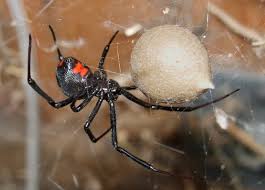
- Adult female: shiny black with long black legs and a round abdomen. The hourglass on the underside is red or orange. She’s about ½ inch long, not counting legs.
- Male: much smaller and lighter colored, with streaks on the abdomen. Males rarely bite. Almost all serious black widow bites come from adult females.
- Young spiders: start out tan and white, then develop stripes. The solid black comes with age.
Want to know about the other spiders people worry about? See our guide to Oregon’s venomous spiders, including why brown recluses aren’t on the list.
How dangerous is a black widow bite?
It’s the one Oregon spider bite that deserves a doctor visit, but it’s rarely as bad as its reputation. ODA calls black widows likely the most harmful spiders in Oregon. It also says the venom from a bite usually isn’t enough to cause a serious reaction in most people.
The bite itself may feel like a pinprick, or like nothing at all. Symptoms that follow can include belly cramps, nausea, heavy sweating, tremors, fever and trouble breathing. They often last only a few days. A black widow bite doesn’t rot the skin around it; that’s a myth.
Black widows don’t go after people. Bites happen when someone presses on one, like reaching into a box or picking up firewood.
If you think you’ve been bitten:
- Get medical care right away. That’s ODA’s advice for any suspected black widow bite.
- Trouble breathing: call 911.
- Questions: call the Oregon Poison Center at 1-800-222-1222, open 24 hours a day.
- Bring the spider or a photo if you can do it safely.
There’s an antivenom, and it works fast. It’s made from horse serum, so doctors watch closely for allergic reactions when they use it.
When are black widows most active in Oregon?
They hide during the day and come out at night. Our technicians see the most in midsummer, especially in Josephine County, but we find them most of the year.
Our records follow the same curve. Across all our spider and general bug jobs, June and July held 37% of the work over the last two years.
How do I get rid of black widows?
- Clear out hiding spots. Move woodpiles away from the house, and keep the foundation clear of clutter, leaf litter and heavy ground cover.
- Vacuum webs and spiders in corners, windows and storage areas.
- Seal gaps around pipes and wires where they go into the wall.
- Just one spider? A fly swatter works better than a can of spray.
Spray alone won’t fix it. UC Integrated Pest Management notes that insecticides don’t give long-term control of widow spiders, which is why the cleanup matters as much as the treatment.
How Bug Zapper handles black widows
We look where they actually live: meter and valve boxes, crawl spaces, woodpiles, eaves and the gaps around pipes. We knock down webs and egg sacs, then treat those spots and the perimeter. A single egg sac holds about 300 eggs, so the sacs matter.
We’ll also point out the woodpile or clutter that’s keeping them around.
On a plan, if they come back, so do we, at no extra cost. That’s our 1-year Pest-Free Promise. See how our spider control works.
We treat black widows across Oregon, including Grants Pass, Medford and Roseburg.
Black widows in the woodpile? Webs in the meter box? We should talk. Call 541-636-0146 or get a free quote.
Locally owned for fast, exceptional service.
5 Star Pest Control Service available in Albany, Ashland, Corvallis, Eugene, Grants Pass, McMinnville, Medford, Newberg, Roseburg, Salem, Sherwood, Wilsonville, Woodburn, Tigard, Tualatin and surrounding areas.
Sources
- Oregon Department of Agriculture: Oregon Spiders: Fact and Fiction (PDF)
- Oregon Department of Agriculture: More About Spiders (PDF)
- Douglas County Master Gardeners (OSU Extension): Black Widow Spiders (PDF)
- UC Statewide Integrated Pest Management Program: Widow spiders and their relatives
- Oregon Poison Center (OHSU): Contact
- Bug Zapper technician field notes, and service records October 2024–September 2026 (spider and general bug jobs, all of Oregon)