Oregon Poisonous Spiders
Written by Jacob Lander, owner and ODA-licensed applicator · Updated October 2026
What venomous spiders live in Oregon? Only one Oregon spider is a real medical concern: the western black widow, most common in southwestern and eastern Oregon. Brown recluses don’t live here. Hobo spiders were blamed for bad bites for years, but the CDC has dropped them from its list of venomous spiders, and verified Oregon bites haven’t backed up the reputation. Nearly every spider has venom. Very few can hurt people.
Found a big brown spider in the house this fall? You probably want to know one thing: is it dangerous? In Oregon, almost certainly not.
This guide covers the spiders Oregon families worry about, the one that actually deserves respect, and when a bite needs a doctor.
Are there brown recluse spiders in Oregon?
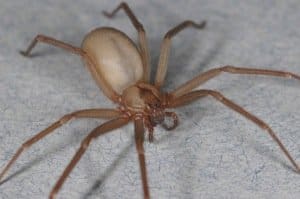
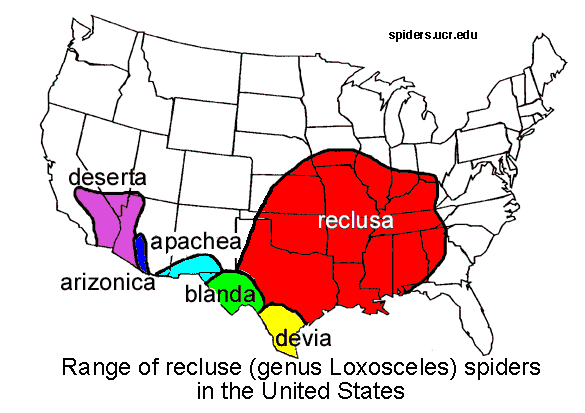
No. The Oregon Department of Agriculture puts it plainly: the brown recluse “does not occur in Oregon, despite reports to the contrary.” The spider lab at Lewis & Clark College in Portland says the same.
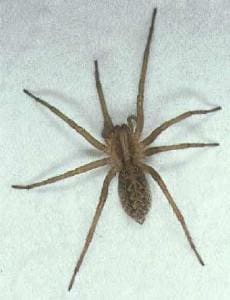
So what’s in your garage? Usually a hobo spider or a giant house spider. Both are brown, fast and long-legged. Hobo spiders are the spiders people send to ODA for identification more than any other.
Are hobo spiders dangerous?
Probably not. Hobo spiders were blamed for years for bites that turned into open wounds, but the evidence never showed up. A 2014 study of 33 verified spider bites in Oregon, one of them from a hobo spider, found that none caused serious symptoms or tissue damage. The CDC has removed the hobo spider from its list of venomous spiders. In Europe, where it comes from, it’s considered harmless.
Like any spider, a hobo can bite if it gets trapped against your skin. That’s about the extent of it.
What’s the big brown spider in my house?
In late summer and fall, it’s almost always a giant house spider or a hobo spider. ODA says most of these spiders turn up from late summer through early fall because the males leave their shelters to look for females. That’s why you find them running across the floor at night or stuck in the bathtub.
Telling the two apart is hard. ODA says it often takes a microscope. Both have long, hairy legs and a chevron pattern on the abdomen. A hobo spider runs 1 to 1¾ inches across with its legs; giant house spiders are usually bigger. Neither one is dangerous.
Can’t tell what’s in your garage?
Text us a photo and a real technician will tell you what we can see. Black widows are easy to spot. Hobos and house spiders are harder. Either way, if you’d rather not share the house with them, we’ll take care of it.
When are spiders worst in Oregon?
Indoors, late summer and fall. That’s when the wandering males show up, and when webs pile up on eaves, porches and windows.
Our records show it too. Over the last two years, October was our busiest month for spider and general bug jobs across Oregon, with 21% of the total. June and July together held another 37%.
Spiders moving in for fall? We treat homes all over Oregon. Get a free quote.
Are there black widows in Oregon?
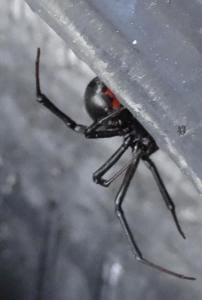
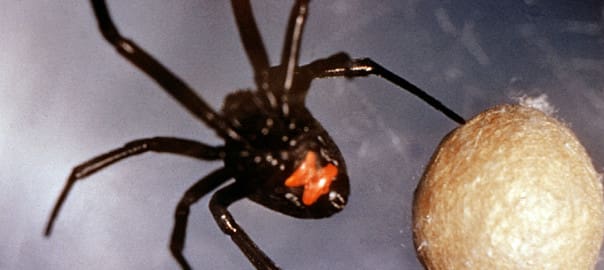
Yes. The western black widow lives here. ODA says it’s most common in southwestern and eastern Oregon and much less common in the northwest. Females are shiny black with a red hourglass on the belly. They build messy, tangled webs in dark, protected spots: woodpiles, crawl spaces, sheds, foundations, under eaves and in stored boxes.
ODA calls black widows likely the most harmful spiders in Oregon. Our full guide to black widow spiders in Oregon covers where they hide around a house and what a bite does.
When should I see a doctor for a spider bite?
- Think a black widow bit you? Get medical care right away. That’s ODA’s advice. Watch for muscle cramps (often in the belly), nausea, heavy sweating, tremors, fever and trouble breathing.
- Trouble breathing or signs of shock: call 911.
- Not sure: call the Oregon Poison Center at 1-800-222-1222. It’s open 24 hours a day.
- A sore that keeps getting worse: see a doctor. If you didn’t actually see a spider bite you, ODA says the cause is most likely something else.
For a minor bite, wash it with soap and water, put a cold pack on it, and keep it raised.
How Bug Zapper handles spiders
Spiders follow food. A house with lots of insects around it will have lots of spiders, so we treat for both. Exterior web removal comes with every spider treatment. Then we treat the perimeter, eaves, windows and doors, where spiders and the bugs they eat get in.
If you’re finding black widows, we look for where they’re living, like woodpiles, crawl spaces and stacked boxes, and treat there too. Inside, less clutter in garages, basements and closets means fewer places for spiders to hide.
On a plan, if spiders come back, so do we, at no extra cost. That’s our 1-year Pest-Free Promise. See how our spider control works.
We handle spiders all over Oregon, from Portland and Salem to Eugene, Medford and Grants Pass.
Spiders in the garage? Webs on every eave? We should talk. Call 541-636-0146 or get a free quote.
Sources
- Oregon Department of Agriculture: Oregon Spiders: Fact and Fiction (PDF)
- Oregon Department of Agriculture: More About Spiders (PDF)
- Pacific Northwest Insect Management Handbook: Public health pests: Spiders
- Lewis & Clark College, Binford Spider Lab: Spider FAQ
- McKeown, Vetter and Hendrickson, Toxicon, 2014: Verified spider bites in Oregon (USA) with the intent to assess hobo spider venom toxicity
- Oregon Poison Center (OHSU): Contact
- Bug Zapper service records, October 2024–September 2026 (spider and general bug jobs, all of Oregon)