Kinds of Ants: Identifying Common Ants in Oregon
Written by Jacob Lander, owner and ODA-licensed applicator · Updated October 2026
What kinds of ants live in Oregon? The ants you’ll find in and around Oregon homes are odorous house ants, pavement ants, carpenter ants, moisture ants, velvety tree ants and thatching ants. Odorous house ants are the most common ants inside western Oregon homes. Carpenter ants do the most damage. Fire ants are not established in Oregon.
Ant control starts with the ant. The right fix for one kind can make another worse, so the first job is knowing which one you have.
Here’s how to tell Oregon’s common ants apart, which ones matter, and what the red ants in your yard probably are.
Common ants in Oregon homes
Odorous house ants

These are the tiny dark ants trailing across the kitchen counter. They’re about 1/8 inch long, dark brown to shiny black, and give off a strong smell when crushed. People describe it as coconut, blue cheese or rancid butter. That’s why they’re also called sugar ants, stink ants and coconut ants.
They go mostly for sweets. They don’t sting and barely bite. The trouble is numbers: colonies near homes can grow to tens of thousands of workers or more. Disturb one and it can split into new colonies, which is why spraying them often backfires.
Pavement ants

Small, dark brown to black ants that nest under rocks, boards and patios, and along foundations. Under a magnifier, they have two bumps (nodes) between the middle and the back end.
They eat almost anything but favor sugar. They show up inside most often after a heavy rain floods their nests. They can sting, but rarely do.
Carpenter ants
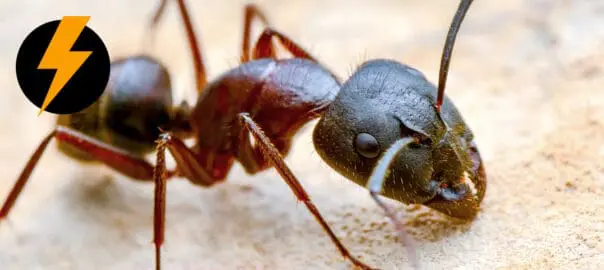
Carpenter ants are the most important structural insect pest in much of the Pacific Northwest, according to the PNW Insect Management Handbook. They’re big: workers run 1/4 to 1/2 inch, and queens reach 3/4 inch. They can be black, red, or red and black, so color alone won’t tell you. The one most often found in Northwest homes is black with reddish-brown legs.
They don’t eat wood. They tunnel into it to nest, often starting where wood is wet or rotting, then spreading into sound, dry wood and insulation. The nest in your wall is often a satellite of a bigger colony outside. Homes near the woods see more of them.
Signs: piles of sawdust near small holes, big winged ants inside in late winter or spring, and a faint rustling in walls. They bite, but they don’t sting.
Moisture ants
Small ants, about 1/8 inch, ranging from pale cream to brown or black. Some smell like citronella when crushed. They don’t damage wood themselves, but they live in wood that’s already rotting. Finding them is a sign to look for a leak or decay in or under the house. Their winged queens are often mistaken for carpenter ants.
Velvety tree ants

Red-and-black ants with a red middle and a black head and back end, about 1/8 to 1/4 inch long. They usually nest outside in trees and come indoors to nest, not to eat, so you won’t often see them at the pet bowl. They can damage insulation and tunnel into wood. They bite, and they give off a coconut-like smell when crushed, so they get mistaken for odorous house ants and carpenter ants.
Not sure what’s in your kitchen? Our technicians identify ants all over Oregon. Get a free quote.
What are the red ants in my yard in Oregon?
In western Oregon, usually thatching ants. They have a red-orange head, a darker middle and a black back end, and they’re fairly big, 3/16 to 5/16 inch long. Look for a mound of dry plant bits, sometimes two to three feet across.
They’re generally beneficial and rarely come inside. But they bite and spray acid if you disturb the mound, and the bites can blister. Treating just the hole in the top can make them move the colony a few feet.
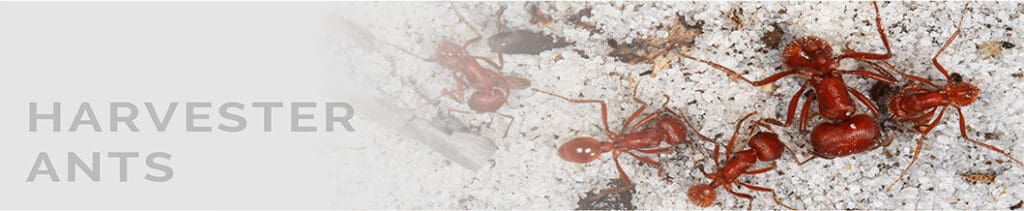
In dry eastern Oregon, red ants clearing bare patches of ground may be harvester ants, which do sting. Velvety tree ants are red and black too, but they live in trees and walls, not mounds.
Are there fire ants in Oregon?
No. Neither the red imported fire ant nor the black imported fire ant is established in the Pacific Northwest. The Oregon Department of Agriculture treats them as a threat to keep out, and asks people to report suspected fire ant colonies or stings.
Many Oregon ants look like fire ants. ODA says it takes an entomologist with a microscope to confirm one.
Which ants bite or sting in Oregon?
- Bite: carpenter ants, thatching ants and velvety tree ants.
- Sting, but rarely: pavement ants.
- Sting: harvester ants, in eastern Oregon.
- Harmless: odorous house ants don’t sting and barely bite.
When are ants worst in Oregon?
Spring, then again in midsummer. Over the last two years, March, April and May held 39% of our ant jobs across Oregon, and July was the single busiest month. Carpenter ants are especially common in spring, and they often swarm after a heavy rain.
Is it ants or termites?
- Waist: ants have a pinched waist. Termites are thick through the middle.
- Antennae: ant antennae bend like an elbow. Termite antennae are straight.
- Wings: a winged ant’s back wings are smaller than its front wings. A termite’s are all about the same size.
- Sawdust: piles of sawdust point to carpenter ants. Termites don’t make sawdust.
Bug Zapper doesn’t treat termites, but our technicians can tell you which one you have. It’s often carpenter ants.
How Bug Zapper handles ants
We identify the ant first, then find where they’re getting in and where they’re nesting, and treat both. With carpenter ants, that means tracking down the nest, including satellite nests in walls.
On a plan, if ants come back between visits, so do we, at no extra cost. That’s our 1-year Pest-Free Promise. See how our ant control works, our Portland ant control, or what attracts ants in the first place.
Ants in the kitchen? Sawdust by the window? We should talk. Call 541-636-0146 or get a free quote.
Sources
- Oregon State University Extension: Solve Pest Problems: Ants
- Oregon State University Extension, Ask Extension: How to control household ants
- OSU/PNW Extension: Integrated Pest Management for Ants in Schools (PNW 761)
- Oregon State University Extension: Carpenter ants (EC 627)
- Pacific Northwest Insect Management Handbook: Nuisance and household pests: Ant and Wood-infesting pests: Ant
- Oregon Department of Agriculture: Red imported fire ant pest alert
- Washington State University PestSense: Thatching ants
- UC Statewide Integrated Pest Management Program: Ants
- Bug Zapper service records, October 2024–September 2026 (ant jobs, all of Oregon)